 Add to Chrome
 Add to Firefox
 Add to Edge
StepAudio 2.5 Technical Report
May 22, 2026
Unified audio-language modeling has emerged as a prominent trend in modern speech systems, promising to bring the reasoning capabilities of large language models to auditory tasks. However, existing unified foundations often struggle to match the depth of specialized systems across automatic speech recognition (ASR), text-to-speech synthesis (TTS), and realtime spoken interaction. Bridging this gap remains an open challenge. This report presents StepAudio 2.5, a unified audio-language foundation model that matches or exceeds specialized systems across all three capabilities. Rather than treating these tasks as architecturally distinct, we operate on the premise that once text and audio share a multimodal representational space, task specialization becomes a matter of operational regimes: data construction, optimization targets, and decoding constraints. Guided by this insight, we advance the post-training paradigm from standard supervised learning to task-tailored Reinforcement Learning from Human Feedback (RLHF), using it as the primary mechanism to define complex optimization targets. We leverage this RLHF-centric alignment, alongside specialized decoding, to shape a shared backbone into three distinct operational modes. Concretely, the ASR branch advances transcription efficiency via verifiable multi-token decoding; the TTS branch achieves controllable, expressive synthesis through preference-based RLHF and context-rich supervision; and the Realtime branch realizes low-latency, persona-consistent dialogue via generative reward modeling within an RLHF framework. On standard benchmarks, StepAudio 2.5 achieves state-of-the-art results across ASR, TTS, and Realtime, demonstrating that a singular audio-language foundation can successfully internalize the distinct deployment objectives of speech understanding, generation, and live interaction.

EponaV2: Driving World Model with Comprehensive Future Reasoning
May 14, 2026Data scaling plays a pivotal role in the pursuit of general intelligence. However, the prevailing perception-planning paradigm in autonomous driving relies heavily on expensive manual annotations to supervise trajectory planning, which severely limits its scalability. Conversely, although existing perception-free driving world models achieve impressive driving performance, their real-world reasoning ability for planning is solely built on next frame image forecasting. Due to the lack of enough supervision, these models often struggle with comprehensive scene understanding, resulting in unsatisfactory trajectory planning. In this paper, we propose EponaV2, a novel paradigm of driving world models, which achieves high-quality planning with comprehensive future reasoning. Inspired by how human drivers anticipate 3D geometry and semantics, we train our model to forecast more comprehensive future representations, which can be additionally decoded to future geometry and semantic maps. Extracting the 3D and semantic modalities enables our model to deeply understand the surrounding environment, and the future prediction task significantly enhances the real-world reasoning capabilities of EponaV2, ultimately leading to improved trajectory planning. Moreover, inspired by the training recipe of Large Language Models (LLMs), we introduce a flow matching group relative policy optimization mechanism to further improve planning accuracy. The state-of-the-art (SOTA) performances of EponaV2 among perception-free models on three NAVSIM benchmarks (+1.3PDMS, +5.5EPDMS) demonstrate the effectiveness of our methods.
Spectrum Matching: a Unified Perspective for Superior Diffusability in Latent Diffusion
Mar 15, 2026In this paper, we study the diffusability (learnability) of variational autoencoders (VAE) in latent diffusion. First, we show that pixel-space diffusion trained with an MSE objective is inherently biased toward learning low and mid spatial frequencies, and that the power-law power spectral density (PSD) of natural images makes this bias perceptually beneficial. Motivated by this result, we propose the \emph{Spectrum Matching Hypothesis}: latents with superior diffusability should (i) follow a flattened power-law PSD (\emph{Encoding Spectrum Matching}, ESM) and (ii) preserve frequency-to-frequency semantic correspondence through the decoder (\emph{Decoding Spectrum Matching}, DSM). In practice, we apply ESM by matching the PSD between images and latents, and DSM via shared spectral masking with frequency-aligned reconstruction. Importantly, Spectrum Matching provides a unified view that clarifies prior observations of over-noisy or over-smoothed latents, and interprets several recent methods as special cases (e.g., VA-VAE, EQ-VAE). Experiments suggest that Spectrum Matching yields superior diffusion generation on CelebA and ImageNet datasets, and outperforms prior approaches. Finally, we extend the spectral view to representation alignment (REPA): we show that the directional spectral energy of the target representation is crucial for REPA, and propose a DoG-based method to further improve the performance of REPA. Our code is available https://github.com/forever208/SpectrumMatching.
Entropy-Guided k-Guard Sampling for Long-Horizon Autoregressive Video Generation
Jan 27, 2026Autoregressive (AR) architectures have achieved significant successes in LLMs, inspiring explorations for video generation. In LLMs, top-p/top-k sampling strategies work exceptionally well: language tokens have high semantic density and low redundancy, so a fixed size of token candidates already strikes a balance between semantic accuracy and generation diversity. In contrast, video tokens have low semantic density and high spatio-temporal redundancy. This mismatch makes static top-k/top-p strategies ineffective for video decoders: they either introduce unnecessary randomness for low-uncertainty regions (static backgrounds) or get stuck in early errors for high-uncertainty regions (foreground objects). Prediction errors will accumulate as more frames are generated and eventually severely degrade long-horizon quality. To address this, we propose Entropy-Guided k-Guard (ENkG) sampling, a simple yet effective strategy that adapts sampling to token-wise dispersion, quantified by the entropy of each token's predicted distribution. ENkG uses adaptive token candidate sizes: for low-entropy regions, it employs fewer candidates to suppress redundant noise and preserve structural integrity; for high-entropy regions, it uses more candidates to mitigate error compounding. ENkG is model-agnostic, training-free, and adds negligible overhead. Experiments demonstrate consistent improvements in perceptual quality and structural stability compared to static top-k/top-p strategies.
RLVMR: Reinforcement Learning with Verifiable Meta-Reasoning Rewards for Robust Long-Horizon Agents
Jul 30, 2025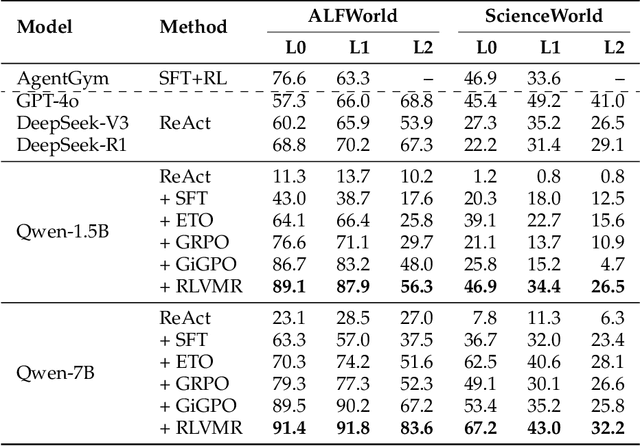
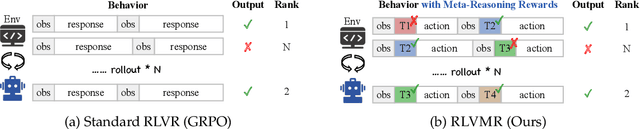
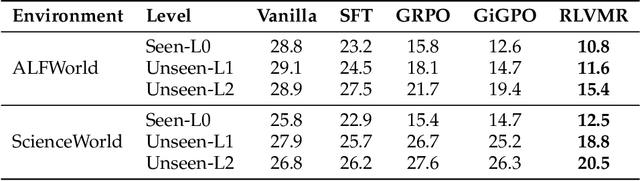
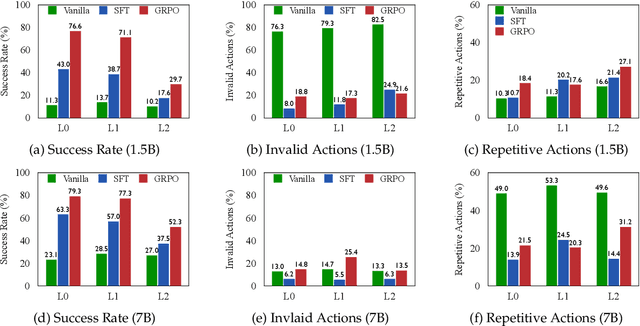
The development of autonomous agents for complex, long-horizon tasks is a central goal in AI. However, dominant training paradigms face a critical limitation: reinforcement learning (RL) methods that optimize solely for final task success often reinforce flawed or inefficient reasoning paths, a problem we term inefficient exploration. This leads to agents that are brittle and fail to generalize, as they learn to find solutions without learning how to reason coherently. To address this, we introduce RLVMR, a novel framework that integrates dense, process-level supervision into end-to-end RL by rewarding verifiable, meta-reasoning behaviors. RLVMR equips an agent to explicitly tag its cognitive steps, such as planning, exploration, and reflection, and provides programmatic, rule-based rewards for actions that contribute to effective problem-solving. These process-centric rewards are combined with the final outcome signal and optimized using a critic-free policy gradient method. On the challenging ALFWorld and ScienceWorld benchmarks, RLVMR achieves new state-of-the-art results, with our 7B model reaching an 83.6% success rate on the most difficult unseen task split. Our analysis confirms these gains stem from improved reasoning quality, including significant reductions in redundant actions and enhanced error recovery, leading to more robust, efficient, and interpretable agents.
Step-Audio 2 Technical Report
Jul 24, 2025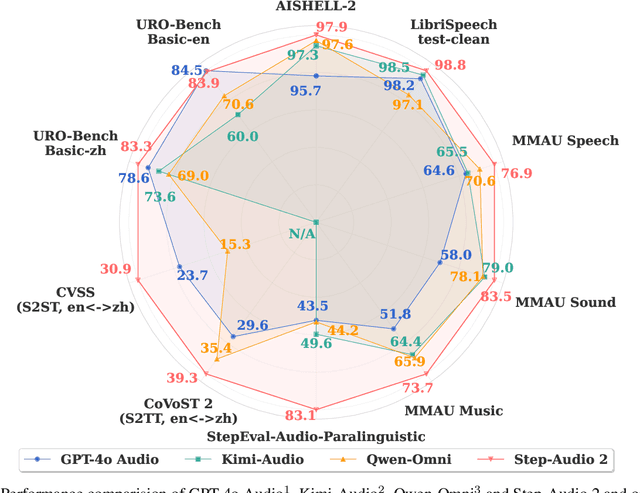
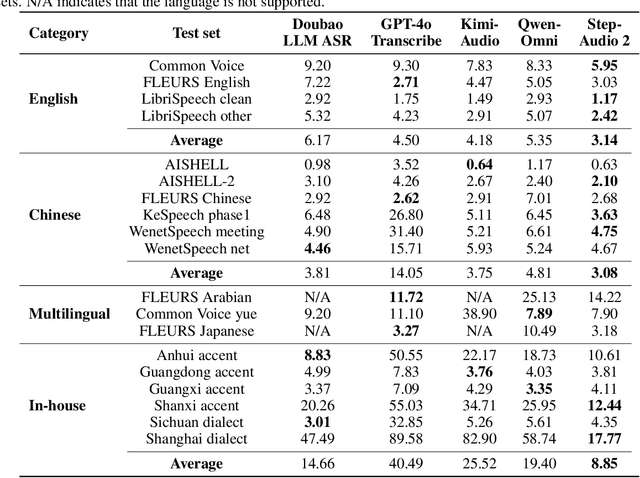
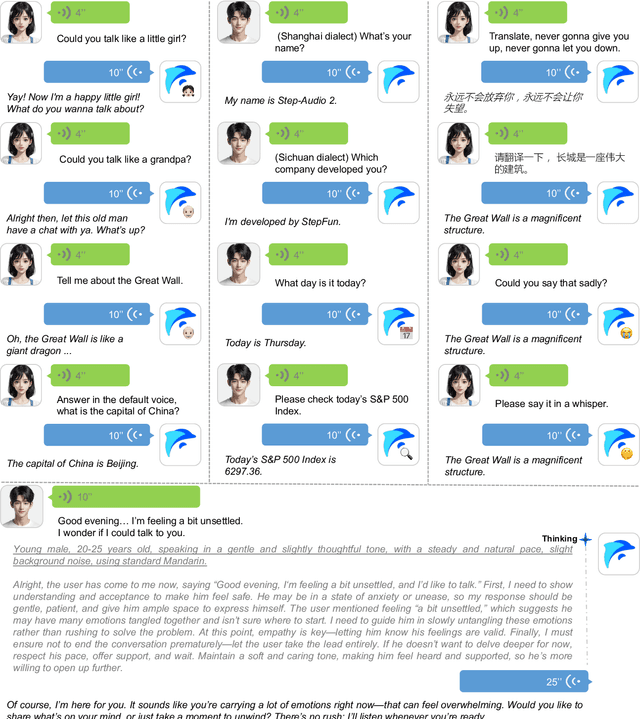
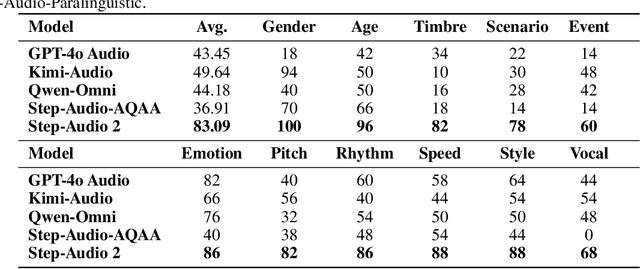
This paper presents Step-Audio 2, an end-to-end multi-modal large language model designed for industry-strength audio understanding and speech conversation. By integrating a latent audio encoder and reasoning-centric reinforcement learning (RL), Step-Audio 2 achieves promising performance in automatic speech recognition (ASR) and audio understanding. To facilitate genuine end-to-end speech conversation, Step-Audio 2 incorporates the generation of discrete audio tokens into language modeling, significantly enhancing its responsiveness to paralinguistic information such as speaking styles and emotions. To effectively leverage the rich textual and acoustic knowledge in real-world data, Step-Audio 2 integrates retrieval-augmented generation (RAG) and is able to call external tools such as web search to mitigate hallucination and audio search to switch timbres. Trained on millions of hours of speech and audio data, Step-Audio 2 delivers intelligence and expressiveness across diverse conversational scenarios. Evaluation results demonstrate that Step-Audio 2 achieves state-of-the-art performance on various audio understanding and conversational benchmarks compared to other open-source and commercial solutions. Please visit https://github.com/stepfun-ai/Step-Audio2 for more information.
Mitigating Negative Interference in Multilingual Sequential Knowledge Editing through Null-Space Constraints
Jun 12, 2025Efficiently updating multilingual knowledge in large language models (LLMs), while preserving consistent factual representations across languages, remains a long-standing and unresolved challenge. While deploying separate editing systems for each language might seem viable, this approach incurs substantial costs due to the need to manage multiple models. A more efficient solution involves integrating knowledge updates across all languages into a unified model. However, performing sequential edits across languages often leads to destructive parameter interference, significantly degrading multilingual generalization and the accuracy of injected knowledge. To address this challenge, we propose LangEdit, a novel null-space constrained framework designed to precisely isolate language-specific knowledge updates. The core innovation of LangEdit lies in its ability to project parameter updates for each language onto the orthogonal complement of previous updated subspaces. This approach mathematically guarantees update independence while preserving multilingual generalization capabilities. We conduct a comprehensive evaluation across three model architectures, six languages, and four downstream tasks, demonstrating that LangEdit effectively mitigates parameter interference and outperforms existing state-of-the-art editing methods. Our results highlight its potential for enabling efficient and accurate multilingual knowledge updates in LLMs. The code is available at https://github.com/VRCMF/LangEdit.git.
Consistent Story Generation with Asymmetry Zigzag Sampling
Jun 12, 2025Text-to-image generation models have made significant progress in producing high-quality images from textual descriptions, yet they continue to struggle with maintaining subject consistency across multiple images, a fundamental requirement for visual storytelling. Existing methods attempt to address this by either fine-tuning models on large-scale story visualization datasets, which is resource-intensive, or by using training-free techniques that share information across generations, which still yield limited success. In this paper, we introduce a novel training-free sampling strategy called Zigzag Sampling with Asymmetric Prompts and Visual Sharing to enhance subject consistency in visual story generation. Our approach proposes a zigzag sampling mechanism that alternates between asymmetric prompting to retain subject characteristics, while a visual sharing module transfers visual cues across generated images to %further enforce consistency. Experimental results, based on both quantitative metrics and qualitative evaluations, demonstrate that our method significantly outperforms previous approaches in generating coherent and consistent visual stories. The code is available at https://github.com/Mingxiao-Li/Asymmetry-Zigzag-StoryDiffusion.
VISTA: Enhancing Vision-Text Alignment in MLLMs via Cross-Modal Mutual Information Maximization
May 19, 2025Current multimodal large language models (MLLMs) face a critical challenge in modality alignment, often exhibiting a bias towards textual information at the expense of other modalities like vision. This paper conducts a systematic information-theoretic analysis of the widely used cross-entropy loss in MLLMs, uncovering its implicit alignment objective. Our theoretical investigation reveals that this implicit objective has inherent limitations, leading to a degradation of cross-modal alignment as text sequence length increases, thereby hindering effective multimodal information fusion. To overcome these drawbacks, we propose Vision-Text Alignment (VISTA), a novel approach guided by our theoretical insights. VISTA introduces an explicit alignment objective designed to maximize cross-modal mutual information, preventing the degradation of visual alignment. Notably, VISTA enhances the visual understanding capabilities of existing MLLMs without requiring any additional trainable modules or extra training data, making it both efficient and practical. Our method significantly outperforms baseline models across more than a dozen benchmark datasets, including VQAv2, MMStar, and MME, paving the way for new directions in MLLM modal alignment research.
Towards More Accurate Personalized Image Generation: Addressing Overfitting and Evaluation Bias
Mar 09, 2025Personalized image generation via text prompts has great potential to improve daily life and professional work by facilitating the creation of customized visual content. The aim of image personalization is to create images based on a user-provided subject while maintaining both consistency of the subject and flexibility to accommodate various textual descriptions of that subject. However, current methods face challenges in ensuring fidelity to the text prompt while not overfitting to the training data. In this work, we introduce a novel training pipeline that incorporates an attractor to filter out distractions in training images, allowing the model to focus on learning an effective representation of the personalized subject. Moreover, current evaluation methods struggle due to the lack of a dedicated test set. The evaluation set-up typically relies on the training data of the personalization task to compute text-image and image-image similarity scores, which, while useful, tend to overestimate performance. Although human evaluations are commonly used as an alternative, they often suffer from bias and inconsistency. To address these issues, we curate a diverse and high-quality test set with well-designed prompts. With this new benchmark, automatic evaluation metrics can reliably assess model performance